

Parking structure condition assessment
De-icing salt is the leading cause of rebar corrosion in parking decks. Map at-risk zones systematically across every level and bay — before spalling turns into structural repair.
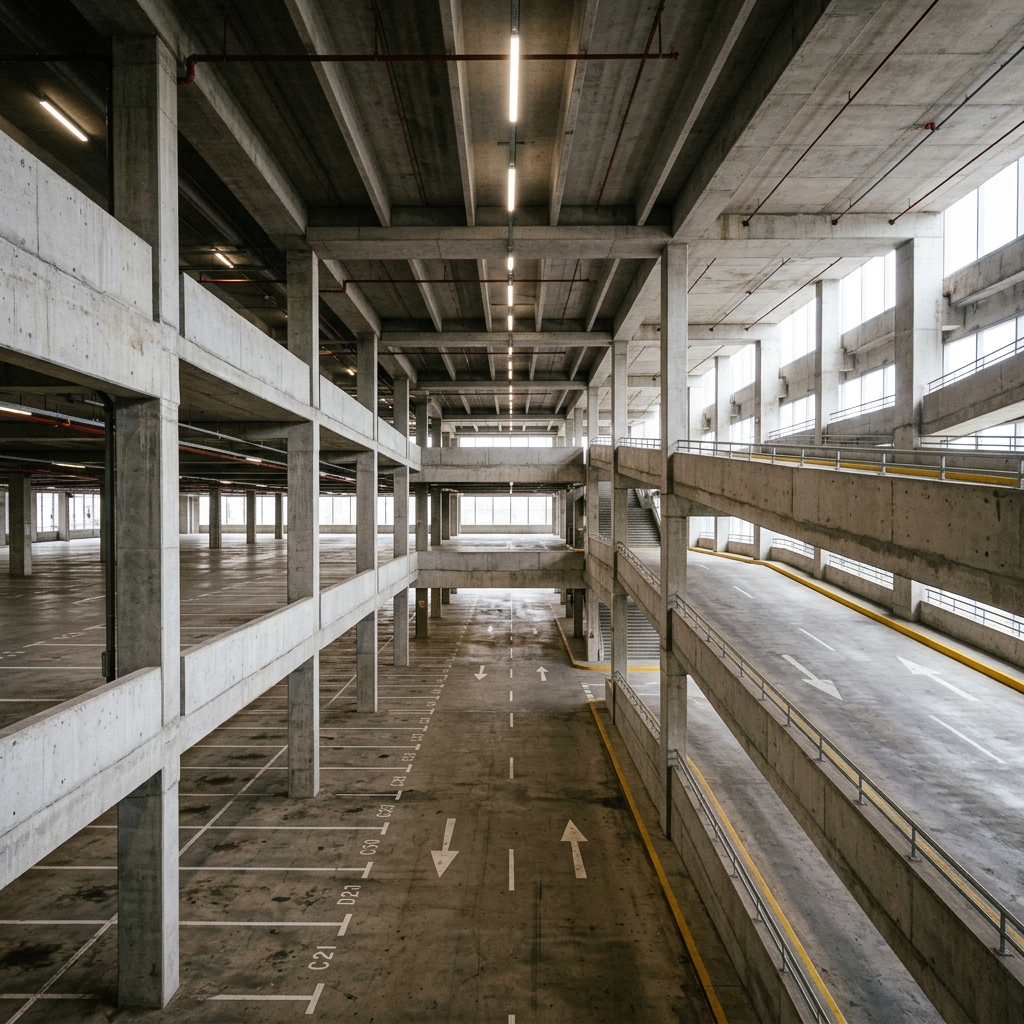
Multi-level complexity demands systematic surveys
Parking structures are uniquely exposed to chloride attack from road salt, tyre-tracked contamination and inadequate drainage. Crack mapping alone misses the subsurface corrosion that later causes spalling.
- Grid-based surveys per bay identify hot zones before surface damage appears
- Multi-level collection with automatic per-level heatmaps
- Thermal monitoring flags trapped moisture and drainage failure
- Year-over-year trending quantifies corrosion progression
What a deck survey uses
Corrosion mapping (ASTM C876 / RILEM)
Grid-based half-cell surveys per bay, level and ramp, with Bluetooth sensor pairing.
Temperature gradient monitoring
Detect thermal variation across levels from sun exposure, HVAC and concrete thermal mass.
Moisture content (WME)
Identify ingress from failed membranes, blocked drains or expansion joints.
Blueprint grid alignment
Align measurement grids to the bay layout and attach readings to stall numbering.
Multi-level comparison
Compare severity across levels and drive lanes to prioritise where the repair budget goes.
Report generation
Per-level heatmaps, priority zone maps and rehabilitation matrices, generated from the survey.
Ready to assess your parking structure?
Request a demo and see how multi-level corrosion mapping works in practice.